FORTIFIED Multifamily™ is a voluntary, beyond-code construction standard developed by the Insurance Institute for Business and Home Safety (IBHS) for apartments, condos, and other multifamily properties. Nearly one in three Americans lives in a multifamily building. When those buildings fail in a storm, entire communities lose their footing. FORTIFIED Multifamily is designed to keep residents in their homes and communities on their feet.
The standard includes three tiers: Roof, Silver, and Gold, each building on the last to provide progressively greater protection against wind, wind-driven rain, and hail.
The three levels
Roof: Strengthens roof deck attachment, seals the deck against water intrusion, and locks down the roof edge. This is the entry level and the foundation for all higher tiers.
Silver: Includes everything in Roof and adds protection for openings, including windows, doors, and other vulnerable components, preventing wind and water from entering when they fail.
Gold: Includes everything in Roof and Silver and requires a continuous load path that ties the roof, walls, and foundation together so the entire structure performs as a system under wind loading. Gold is the most commonly required level in federal and state funding programs.
Why it matters for developers
A 2022 study by the Alabama Center for Insurance Information and Research found that building to the FORTIFIED Multifamily standard produces meaningful returns for property owners, including reduced insurance premiums, lower retained losses such as deductibles, and greater insurance availability. Return on investment can reach as high as 72%.
Beyond ROI, FORTIFIED Multifamily makes properties more insurable and more financeable. Lenders and investors increasingly factor weather resilience into underwriting decisions. A building that is demonstrably less likely to sustain damage, file claims, or require displacement of tenants after a storm is a lower-risk asset. FORTIFIED designation provides the third-party verified documentation to support that case.
FORTIFIED Multifamily also reduces the operational disruption that follows a storm. Tenant displacement is costly, both in lost revenue and in the community relationships that make a property viable long term. Buildings that stay intact keep residents home and keep income stable.
SHA provides technical assistance to developers and housing agencies pursuing FORTIFIED Multifamily designation. Contact us if you are working on a project.
Proven in the field
When Category 4 Hurricane Ida's eye passed directly over Lockport, Louisiana, two apartment complexes sat half a mile apart. One was built to the FORTIFIED Commercial standard. It sustained minor damage and reopened three weeks after the storm. The other was destroyed. Families displaced from the destroyed building moved in.

How the process works
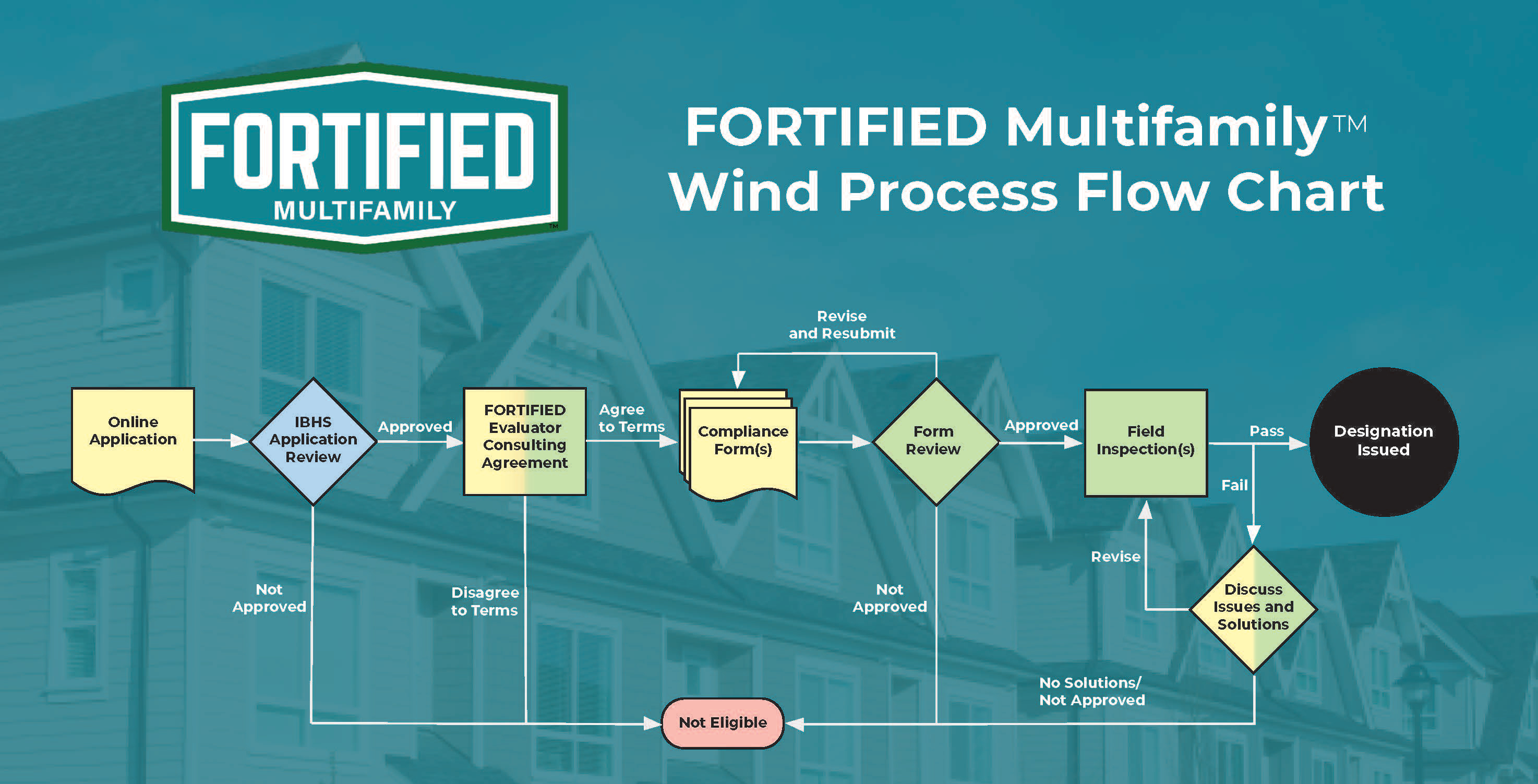
FORTIFIED Multifamily requires developers to apply with IBHS before construction begins. The flowchart below shows the typical process.
Learn more and apply
For full technical specifications, standards documentation, and the application process, visit fortifiedhome.org/fortified-multifamily.